Dear Santa,
We've been VERY good this year. We've practiced our speech sounds, built our vocabulary, worked on taking turns, and celebrated lots and LOTS of communication milestones. So we thought we'd help you out with a few ideas for your holiday shopping list!
At Sound Speech & Hearing Clinic, we spend a lot of time playing with toys. And while it might look like we're just having fun (we definitely are!), play is one of the most powerful ways children learn to communicate. With the holidays approaching, we asked our Sound team to share their favorite toys for encouraging speech, language, listening, and learning.
What's on Sound's Holiday Wish List?
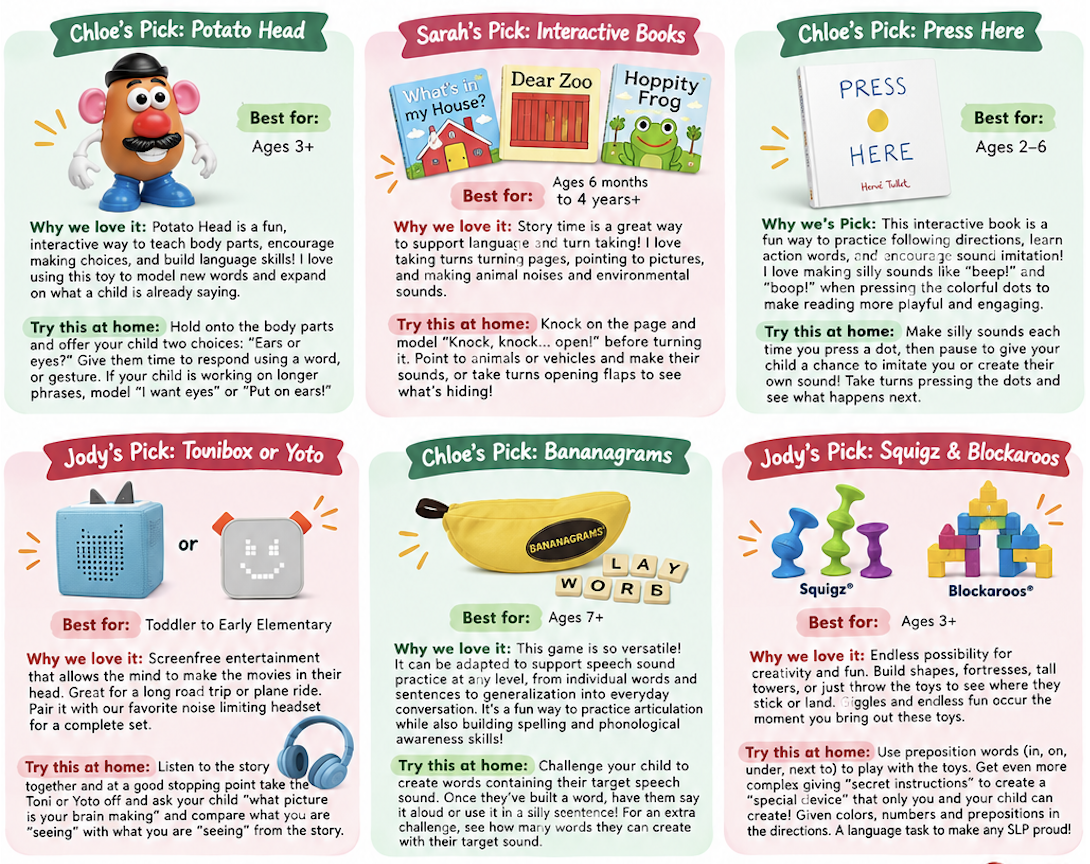
Chloe's Pick: Potato Head
Best for: Ages 3+
Why we love it: Potato Head is a fun, interactive way to teach body parts, encourage making choices, and build language skills! I love using this toy to model new words and expand on what a child is already saying.
Try this at home: Hold onto the body parts and offer your child two choices: "Ears or eyes?" Give them time to respond using a word, or gesture. If your child is working on longer phrases, model "I want eyes" or "Put on ears!"
Sarah’s Pick: Interactive books with textures to touch, flaps to open, and tabs to pull like What’s in my House?, Dear Zoo or Hoppity Frog
Best for: Ages 6 months to 4 years+
Why we love it: Story time is a great way to support language and turn taking! I love taking turns turning pages, pointing to pictures, and making animal noises and environmental sounds.
Try this at home: Knock on the page and model “Knock, knock... open!” before turning it. Point to animals or vehicles and make their sounds, or take turns opening flaps to see what’s hiding!
Chloe's Pick: Press Here by Hervé Tullet
Best for: Ages 2–6
Why we love it: This interactive book is a fun way to practice following directions, learn action words, and encourage sound imitation! I love making silly sounds like "beep!" and "boop!" when pressing the colorful dots to make reading more playful and engaging.
Try this at home: Make silly sounds each time you press a dot, then pause to give your child a chance to imitate you or create their own sound! Take turns pressing the dots and see what happens next.
Best for: Toddler to Early Elementary
Why we love it: Screenfree entertainment that allows the mind to make the movies in their head. Great for a long road trip or plane ride. Pair it with our favorite noise liming headset for a complete set.
Try this at home: Listen to the story together and at a good stopping point take the Toni or Yoto off and ask your child “what picture is your brain making” and compare what they are “seeing” with what you are “seeing” from the story.
Chloe's Pick: Bananagrams
Best for: Ages 7+
Why we love it: This game is so versatile! It can be adapted to support speech sound practice at any level, from individual words and sentences to generalization into everyday conversation. It's a fun way to practice articulation while also building spelling and phonological awareness skills!
Try this at home: Challenge your child to create words containing their target speech sound. Once they've built a word, have them say it aloud or use it in a silly sentence! For an extra challenge, see how many words they can create with their target sound.
Jody’s Pick: Squigz and Blockaroos
Best for: 3+
Why we love it: Endless possibility for creativity and fun. Build shapes, fortresses, tall towers, or just throw the toys to see where they stick or land. Giggles and endless fun occur the moment you bring out these toys.
Try this at home: Use preposition words (in, on, under, next to) to play with the toys. Get even more complex giving “secret instructions” to create a “special device” that only you and your child can create! Given colors, numbers and prepositions in the directions. A language task to make any SLP proud!
What Makes a Toy Great for Communication?
When our speech therapists choose toys, we're often looking for opportunities rather than features. We love toys that encourage:
Imaginative play: Pretend food, dolls, vehicles, and play sets create opportunities for storytelling and social interaction.
Turn-taking: Games and shared activities help children practice the back-and-forth nature of communication.
Descriptive language: Blocks, puzzles, and sorting toys encourage children to explore colors, shapes, sizes, and categories.
Problem-solving: Toys that involve building, sequencing, and planning create natural opportunities for asking questions and sharing ideas.
Connection: Our favorite toys are often the ones that bring children and caregivers together.
Our Biggest Holiday Toy Tip? No matter what toy you’re using, the most important gift is time playing together! Happy Playing and Happy Holidays! We hope our Sound-approved holiday gift guide makes shopping a little easier and playtime a lot more fun.
From all of us at Sound Speech & Hearing Clinic, we wish you a holiday season full of imagination, laughter, learning, and plenty of play.
Love, Your Sound Speech Therapists (and Audiologists, Too)